

Chat with your Data: How NetSuite Brings AI Directly into the ERP
14. October 2025
Why NetSuite is particularly well suited as an ERP solution for e-commerce and retail
20. January 2026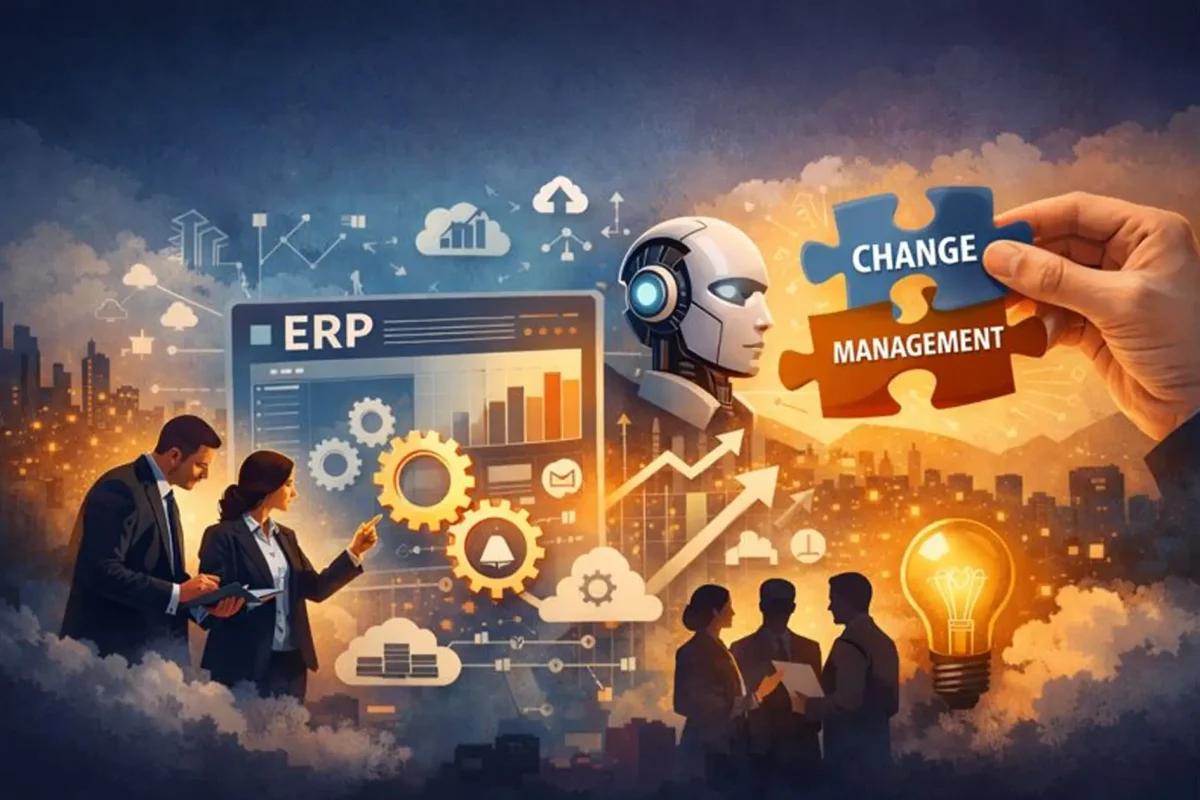
Published on 14. January 2026
ERP Trends 2026 in the DACH Region: How Change Management Puts Them into Practice
This article connects the outlook on ERP and AI trends through 2026 with the reality inside DACH‑based companies and highlights the role the people side of change plays.
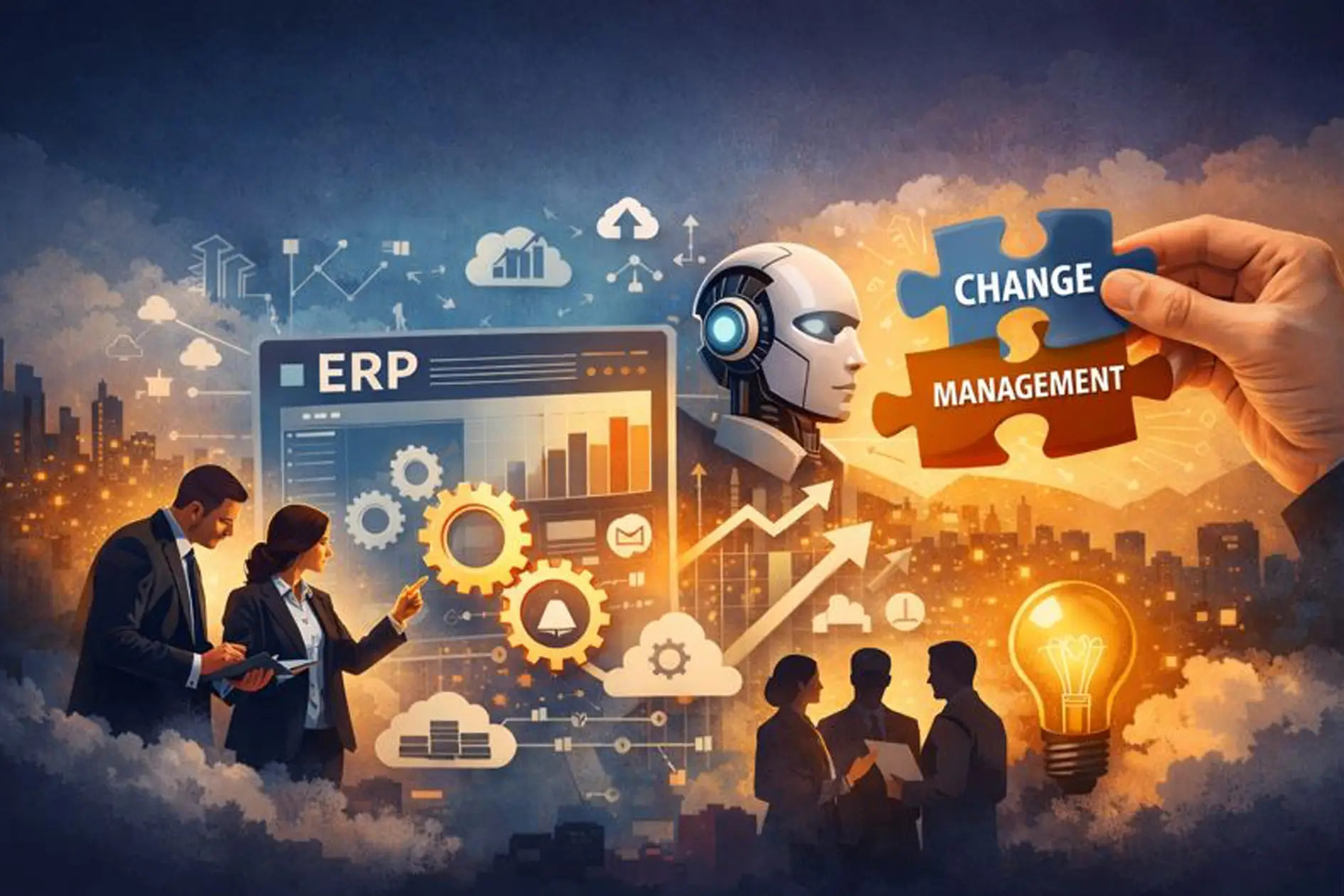
From System of Record to Intelligent ERP Platform
Over the coming years, ERP systems will evolve into increasingly intelligent, more connected, and AI‑enabled platforms. For IT, ERP, and business leaders, the question is therefore less about whether these developments will arrive and more about how much of this can realistically be implemented in their own organization by 2026. Trend reports and market analyses for 2026 paint a picture of solutions where generative AI makes user interfaces more conversational, formulates reports, analyzes or posting suggestions in natural language, predictive models flag demand shifts, supply bottlenecks, cash‑flow risks or maintenance needs at an early stage, and initial agentic AI scenarios take over multi‑step task chains – from stock checks through to prepared purchase proposals. These developments are complemented by established machine‑learning capabilities such as anomaly detection, automated workflows, real‑time analytics, and – in some industries – AI‑supported optimisation of sustainability and ESG metrics.
Many current ERP trend studies for 2026 therefore describe a shift away from purely backward‑looking “systems of record” towards systems that use data more actively: as a conversational partner via natural language, as an early‑warning system embedded in processes, and – in early scenarios – as digital colleagues that prepare routine decisions while people retain accountability and handle exceptions. In modern cloud ERP solutions such as NetSuite, these capabilities are increasingly brought together on integrated platforms.
DACH Realities: Between Trend and Day‑to‑Day Business
Taking a step back from these projections, the picture in the DACH region (Germany, Austria, Switzerland) is much more nuanced. Recent industry surveys show that ERP systems are widely used across the mid‑market, cloud offerings and AI capabilities are becoming more prominent in vendors’ portfolios, and hybrid multi‑cloud strategies are seen as the target architecture. At the same time, many companies still rely on heavily customized legacy systems, Excel bridges, and IT teams that spend much of their time keeping day‑to‑day operations running.
The view on AI is therefore more cautious than euphoric in the DACH context. The potential is recognized, and early use cases – from automated invoice checking through to predictive planning – are delivering convincing results in pilots and specific sub‑areas. Yet questions around data quality, security, liability, governance, and economic viability remain very present. Added to this is a tight labour market: skills shortages and high workload levels in the business functions limit the organization’s capacity for change, often more than budgets or available technology.
Between Transformation Pressure and Change Fatigue
Against this backdrop, 2026 looks less like a point in time when all companies have become cloud‑native, fully AI‑automated ESG frontrunners, and more like a transition phase with very different starting points. Some organizations move ahead and use new ERP and AI capabilities – for example, in NetSuite – as targeted levers for automation and greater autonomy. Others modernize step by step, focusing first on stabilizing processes, cleaning up data, and putting the organization in a position to benefit from these developments at all.
In practice, the challenge for IT, ERP, and business leaders is not whether these dynamics are relevant, but how to shape them at a realistic pace with the resources available. In the DACH region in particular, this brings one question to the forefront: how can ERP trends 2026, AI adoption, and organizational reality – for example, in a NetSuite project – be brought together through a solid, practical ERP change‑management approach?
Studies on digital transformation and the world of work highlight just how wide the spread within organizations actually is. While some companies are facing high change dynamics, multiple parallel initiatives, and rising expectations around efficiency, transparency, and compliance, many employees experience this accumulation as increasingly burdensome. Research on “change fatigue” shows that a significant share of employees feel exhausted by the frequency and intensity of change and initially respond to new initiatives with scepticism or resistance – even when those initiatives are sensible in terms of content.
At the same time, cloud and transformation studies from the DACH region indicate a strong underlying willingness to modernize, but also a degree of realism – and in some cases disillusionment – about how much effort it takes to truly embed new technologies into processes, roles, and ways of working.
Taken together, this leads to a situation where glossy trend images and day‑to‑day business often diverge sharply: on the one hand, ambitious roadmaps for ERP modernization, AI pilots, and new cloud architectures; on the other, teams that have already been through several waves of change are operating with limited resources and have little room to breathe between projects. This is precisely where the “people side of change” moves to the centre – not as a counterpoint to technology, but as an answer to the question of how much change an organisation can realistically absorb at a given point in time, and how ERP and AI initiatives – whether with NetSuite or other systems – can be designed in a way that is understandable, accessible and sustainable.
Conclusion
By 2026, ERP trends and DACH‑region realities will come together where organizations deliberately manage their resources, set clear priorities, and choose a pace of change that fits their context. What matters less is the next trend impulse, and more the conscious design of that pace of change, together with a strong people side of change that ensures ERP and AI initiatives – including NetSuite implementations and roll‑outs – are experienced in day‑to‑day work as a relief rather than an additional burden.
Your Next Step
As a specialised consultancy at the intersection of ERP, AI and change management in the DACH region, we help you realistically assess your organisation’s readiness for change and strengthen the factors that are critical over the course of an ERP project.
Let’s talk about how you can systematically, pragmatically and proactively integrate the human and organisational side into your project.