
Change management for successful ERP implementations
22. January 2026
NetSuite: The Ideal ERP Solution for Professional Services
18. February 2026
Veröffentlicht am 16. February 2026
Challenges in the SaaS Business
Why Subscription Models are More Complex than They Appear
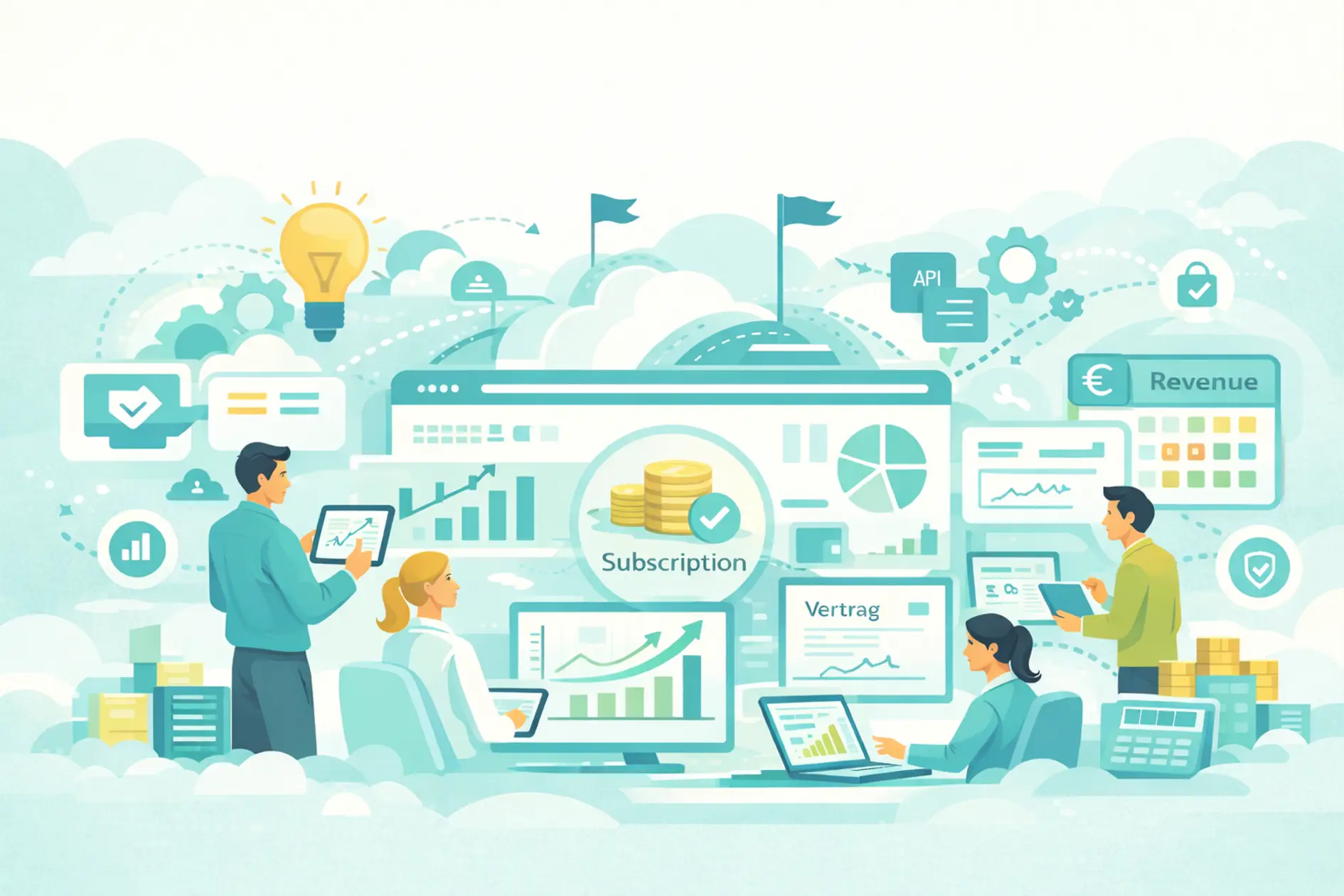
Software-as-a-Service (SaaS) is considered a dream model: recurring revenues, predictable cash flow, attractive company valuations. Many software companies are therefore transitioning their business model to subscriptions – or are already in the process of scaling.
However, a closer look reveals that the SaaS business brings significant operational, financial, and regulatory complexity. Topics such as contract management, revenue recognition, and revenue management are no longer just specialized accounting concerns but strategic C-level tasks.
This article provides a compact overview of the central challenges – and shows how modern systems like Oracle NetSuite can support SaaS companies.
1. From One-Time Sale to Subscription Logic
In the classic on-premise business, the landscape with one-time license sales, annual maintenance, and additional project services was relatively simple:
In the SaaS model, the focuses shift:
-
Recurring revenues (subscriptions, support, add-ons) instead of one-time revenues
-
Ongoing customer relationships instead of "deal closed, project finished"
-
Usage-based billing (seats, volume, API calls, tickets) instead of fixed maintenance fees
This brings three metrics into focus that must be clearly differentiated in the SaaS business:
-
Bookings – contract inventory: What has been contractually secured?
-
Billings – invoicing: What gets billed when?
-
Revenue – income: What can be recognized as revenue according to accounting rules?
For management, this means:
The management of the business model only works if these metrics are consistently represented in the system.
2. Contract Management in the SaaS Environment: Dynamic Lifecycle Instead of Static Contract
SaaS contracts are not static documents that are signed once and then "run." They are living objects with often complex lifecycles:
-
Monthly or yearly terms with automatic renewals
-
Upgrades, downgrades, and add-ons during the term
-
Discounts, promotions, trials, and special conditions
-
Different support levels (standard, premium, 24/7, SLAs)
2.1 Transparency over the Customer Lifecycle
For high-quality C-level oversight, fundamental questions must always be answerable:
-
Which contracts are active, paused, or terminated?
-
Which upgrades/downgrades were agreed upon and when do they take effect?
-
Which services (modules, users, regions, support levels) are covered by which contract?
Without a central, clean contract object, this information quickly becomes dispersed in:
-
CRM
-
Ticket systems
-
Billing solutions
-
Excel spreadsheets
The consequence: lack of consistency and insufficient decision-making basis.
2.2 Renewal Management & Churn as a Central Control Metric
The central growth story of SaaS is based on:
-
Renewal rate
-
Churn rate
-
Net Revenue Retention (NRR)
To actively manage these metrics, you need:
-
Timely initiated renewal processes
-
Clear upgrade paths and cross-selling strategies
-
Transparency regarding usage behavior and customer satisfaction
In practice, this often fails due to a lack of integration:
-
Sales does not see which contracts and usages are actually active.
-
Finance does not see which renewals and expansion effects are in the pipeline.
As such, a comprehensive view of lifetime value, NRR, and profitability is not possible.
2.3 Global Scaling and Variety of Options
With internationalization, complexity increases:
-
Local pricing models, currencies, tax rules
-
Different contract standards and legal requirements
-
Local closures according to HGB, IFRS, or other local GAAP
What is manually manageable in the home market quickly becomes a scaling risk internationally if processes and systems do not grow along with it.
3. Revenue Recognition: When Cash and Revenue Diverge
In the SaaS business, payment receipt and revenue recognition rarely coincide:
-
Annual contract is invoiced and paid in advance
-
Services are rendered over 12 months
-
Accounting must recognize revenues on a period basis
Depending on the accounting standards (e.g., HGB, IFRS 15, ASC 606), different detail rules apply.
3.1 Deferred Revenue
In the German HGB context, this is referred to as deferred revenue (PRAP). The principle is essentially the same:
-
Prepayments are initially recognized as a liability on the balance sheet
-
and recognized as revenue over the term of the contract.
Many companies still manage this volume with Excel spreadsheets, individual macros, and a high degree of manual maintenance.
The risks that can arise are clear:
-
Errors in terms, start/end dates, and remaining terms
-
Contract changes (upgrades, cancellations, extensions) are not consistently tracked
-
High explanation effort towards auditors
3.2 Multi-Component Contracts & IFRS 15
SaaS contracts often include several performance components:
-
Software usage (subscription)
-
Implementation / onboarding
-
Support and maintenance
-
Training or consulting
IFRS 15 requires, among other things:
-
Identification of individual performance obligations
-
Allocation of the total price based on relative standalone selling prices (SSP)
-
Consistent handling of contract modifications
This goes far beyond a simple linear 12-month deferral. Without specialized system support, this is hardly manageable at scale in a compliant manner.
4. Revenue Management: From Simple Booking to Active Control
It is not just about recording revenue correctly but actively managing the revenue potential of the business model.
Central questions include:
-
How should prices, discounts, and bundles be structured to optimize growth and margins?
-
Which customer segments are actually profitable?
-
What impact do price adjustments have on churn and growth?
To answer these questions, financial data, operational data, and contract data must be consolidated:
-
Revenue, deferred revenue, margins
-
Usage, tickets, SLA fulfillment, pipeline
-
Terms, prices, discounts, contract changes
Only if these perspectives are presented in a consistent data model can revenue management transition from a downstream accounting task to a strategic management discipline at the C-level.
5. Increasing Regulatory Density: ASC 606, IFRS 15 & Co.
The requirements for revenue presentation continue to rise.
-
Standards like ASC 606 (US GAAP) and IFRS 15 have raised the bar significantly for revenue recognition.
-
Companies must closely tie revenue to the fulfillment of performance promises.
-
Variable consideration and contract changes must be accurately represented.
-
It is much more transparent to document how sales are generated.
SaaS models with recurring and usage-based revenues are particularly affected – especially when local standards like HGB must also be taken into account.
For C-level management, this means:
Excel-based solutions are not sustainably scalable in the long term.
6. How Modern Systems – Example: Oracle NetSuite – Support SaaS Companies
Many of the challenges described are not purely organizational or process issues, but rather a question of system architecture. Modern cloud ERP systems such as Oracle NetSuite specifically address these issues.
6.1 Advanced Revenue Management (ARM)
With Advanced Revenue Management (ARM), NetSuite automates essential steps of revenue recognition:
-
Revenue templates per product/service
-
e.g., "SaaS 12M linear", "Support 36M linear", "Project based on performance"
-
-
Automatic creation of revenue plans
-
at invoicing, orders, or contracts
-
including the allocation to various performance obligations
-
-
Support for ASC 606 / IFRS 15
-
including allocation of the transaction price according to SSP
-
representation of contract modifications
-
scalable processing of hundreds of thousands of contracts
-
German companies can use the same mechanisms to manage passive accruals (PRAP) using a system-based approach instead of individual Excel logic.
6.2 Multi-Book Accounting
Internationally operating SaaS companies often need to report in parallel:
-
Local financial statements (e.g., HGB in Germany)
-
Consolidated statements under IFRS or US GAAP
With multi-book accounting, NetSuite can:
-
Post the same business transaction to multiple accounting books simultaneously
-
Apply different:
-
Accounts (e.g., special PRAP accounts according to SKR)
-
Revenue recognition rules (simple linearization vs. complex IFRS 15 logic) per book
-
This allows for local and international requirements to be met in parallel without needing to maintain separate system environments and manual bridging solutions.
6.3 Integrated Contract and Subscription Management
NetSuite combines CRM/sales (opportunities, quotes), subscription/contract management (terms, upgrades, renewals), billing and payment, revenue management, and reporting in a single system.
This enables, among other things, a consistent view of bookings, billings, and revenue, better control of MRR/ARR, churn, net revenue retention, and a seamless connection between operational business and financial figures.
For C-level executives, this creates an integrated control platform instead of a multitude of isolated tools.
7. Conclusion: SaaS is Attractive – but Not a Self-Starter
The SaaS business model offers enormous opportunities, but it is not a self-starter. Key takeaways for C-level management:
-
Contract management is becoming more dynamic and complex and must be systemically managed throughout the entire customer lifecycle.
-
Revenue recognition is significantly more challenging due to deferred revenue, multi-component contracts, and new standards like IFRS 15 and ASC 606.
-
Revenue management is evolving into a central management discipline that closely aligns finance, sales, and operations.
-
Regulatory pressure makes isolated Excel solutions unsustainable in the long run.
Those who tackle these issues early on in a structured manner and rely on suitable, integrated systems – such as solutions such as Oracle NetSuite, including Advanced Revenue Management and Multi-Book Accounting – lay the foundation for the SaaS model to deliver on its promise:
scalable growth with predictable, reliable, and regulatory-compliant revenues.