
Why NetSuite is particularly well suited as an ERP solution for e-commerce and retail
20. January 2026
Veröffentlicht am 22. January 2026
Change management for successful ERP implementations
This blog post explains why Change Management is a key success factor in ERP implementations such as NetSuite – and how it drives acceptance, motivation, and sustainable user adoption.

Do I need Change Management for my ERP implementation?
ERP implementation: why it’s about more than just technology
Implementing an ERP system like NetSuite is a complex and strategically critical digital transformation initiative. It reshapes business processes, affects data quality and harmonization, and requires clear roles, governance, and decision-making structures.
At the same time, daily operations continue creating pressure and tension that influence the success of the ERP project.
With this blog series, we examine the human, organizational, and technical dynamics of ERP implementation and address the key question: Do I really need Change Management for my ERP implementation?
The organizational dimensions of an ERP implementation
An ERP system impacts not only IT architectures but also core organizational structures and daily operations. Processes are redesigned, responsibilities shift, and established routines are reassessed and adapted. For many employees, this means adjusting to new workflows, managing additional interfaces, and navigating changing roles and expectations.
Such shifts place high demands on the organization and often create uncertainty — occasionally even resistance. When that happens, decision-making slows down, priorities blur, and the ROI of the ERP investment suffers. Studies and project experience in ERP transformations show that expecting these dynamics to resolve themselves through technology alone rarely works.
Change Management as a key lever in ERP projects
Research and ERP project data consistently show that many implementations achieve only partial success. The pattern is clear: persistent organizational challenges rarely stem from the ERP technology itself, but from the way new processes are integrated into day-to-day work.
Factors such as unclear roles, uncertainty in new processes, and low user acceptance directly impact ERP project success and time-to-value.
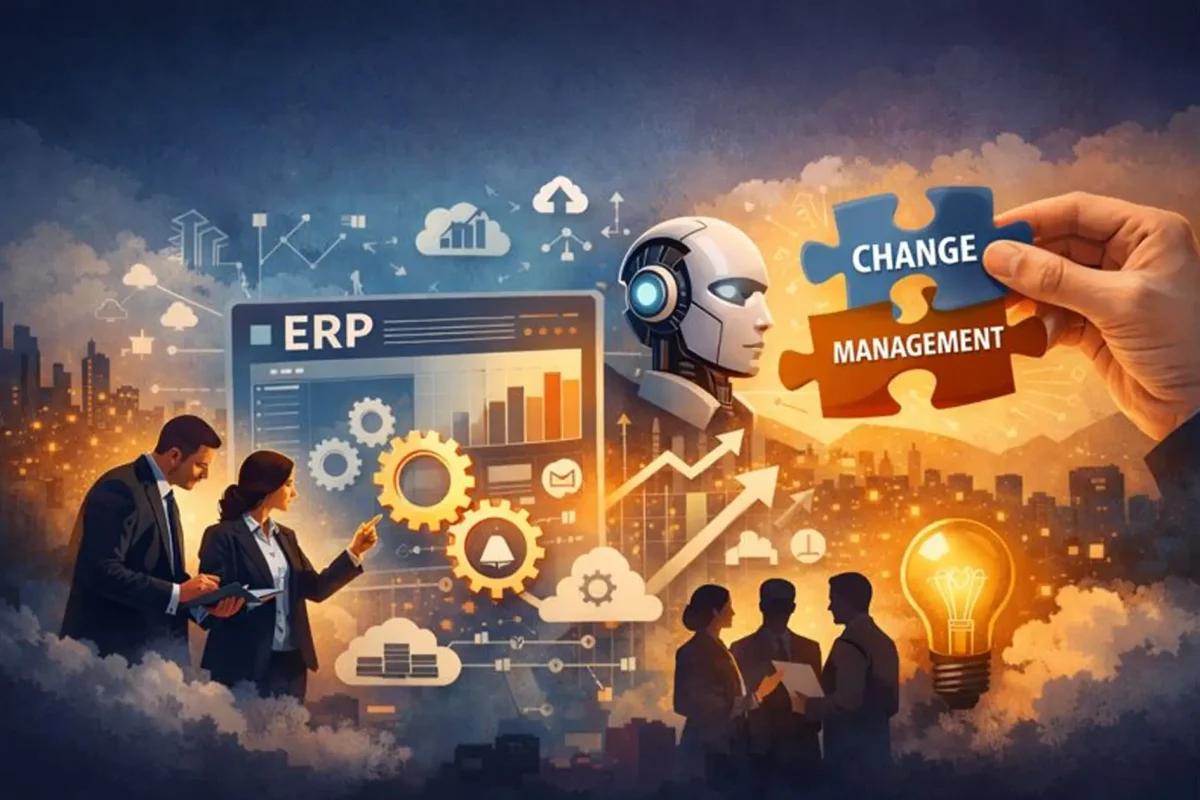
This is precisely where ERP Change Management comes in. It systematically addresses the human and organizational aspects of ERP implementation, providing clarity and helping to build trust while reducing resistance. With structured Change Management, the ERP rollout becomes not only technically complete but also operationally effective and culturally embedded.
In short: what Change Management means in an ERP project
Change Management describes the structured, people-focused approach to ERP and digital transformation. Structured means that the human dimension is intentionally included from the start through clear communication, active engagement, and tailored support for different roles across the organization.
In an ERP implementation such as NetSuite, this approach helps ensure smoother project execution, faster user adoption, and higher long-term ROI. Ultimately, the system is not only implemented but actively used, improved, and sustained in daily work.
Conclusion
The key question is not whether Change Management is needed, but where the greatest project risks and success factors lie and how to mitigate them to protect your ERP investment.
Change Management is not a one-size-fits-all requirement; it is a strategic enabler for ERP success.
Especially where multiple stakeholders are involved, complex processes are redesigned, or user skepticism exists, Change Management becomes essential.
It ensures that ERP systems like NetSuite are not only technically deployed but also fully accepted and effectively used across the organization.
Your next step
The success of any ERP project or digital transformation depends not only on technology, but also on how well your organization embraces and manages change.
Professional ERP Change Management services help you assess organizational readiness, identify potential obstacles early, and strengthen acceptance, communication, and leadership across teams.
This increases the likelihood that your ERP system will deliver sustainable value, user adoption, and measurable business impact.
If you’d like to learn how to integrate Change Management into your ERP project strategy and ensure long-term success, we invite you to start the conversation with us.